Netted
A personal-finance app for realized trade profit, shared investment funds and budgeting. I wrote the accounting rules before any code, enforced MFA inside the database, and wrote a security assessment for non-technical decision makers.
- 7risks in my register, each with an owner, a fix and a due date
- 506journal records restored from an encrypted backup, all hash-matched
- MFAenforced inside the database, so the API can’t skip it
- Exactaccounting rules written before any code, with money in integer cents
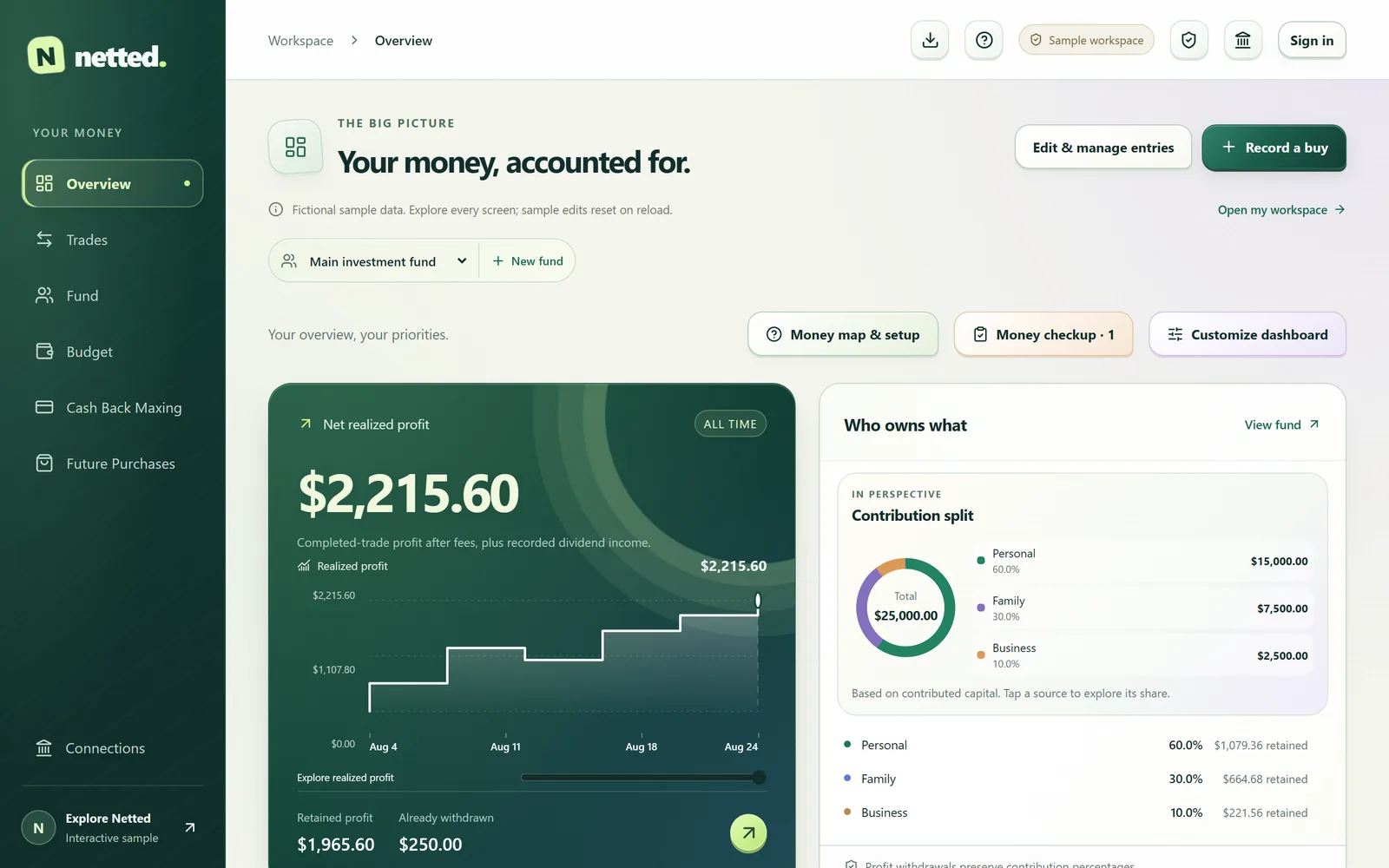
Key decisionFix each contributor's share at purchase time and keep corrections as reversals, so every number can be traced back without rewriting history.
What it shows
Risk written for decision makers
An assessment that explains each control in business terms, with a scorecard and a 7-item risk register.
MFA the API can't skip
A Google password alone doesn't open financial records. Database functions require a verified identity, a live session and an authenticator code.
Exact accounting
Integer cents and exact share quantities. A missing cost basis goes to review instead of being guessed.
A recovery drill
An encrypted backup restored into an isolated database, with every journal record and cent total matched.
Security assessment
I wrote the assessment for people who decide whether a product ships, not for engineers. It explains each control in plain terms, says what the evidence shows, and concludes that the protections work but the app isn't ready for release yet.
| Measure | Result | What it means |
|---|---|---|
| Live site checks | 26 passed | Including 5 forged-origin and 5 signed-out requests, all refused |
| Security and recovery tests | 18 passed | 17 security regressions and a schema rollback |
| Dependency advisories | 0 across 520 | No published flaw in any dependency at review time |
| Release conditions | 0 of 4 closed | Admin access review, backups, hosting eligibility and an outside review |
The risk register tracks 7 open items: 4 high-priority release conditions and 3 medium operating ones. Each has an owner, a deliverable, a measurable acceptance test and a due date, such as "100% of privileged accounts have MFA" and "1 successful full restore with record counts and cent totals reconciled."
Controls
Imports stay on the device
Brokerage CSV and PDF files are parsed in the browser, and only the trades the user reviews are saved. Files are capped at 2 MB and 2,000 rows; PDFs at 20 pages and 15 seconds, read as text only.
No local copies
Financial records never go to browser storage or offline caches. Signing out clears private state, and responses tell browsers and shared caches not to keep copies.
Ownership checked on every write
Direct table writes are denied, and tests confirm one user can't read or reference another user's records.
Isolated from my other apps
Its own hosting project, database and sign-in. The build refuses any other database host and rejects secret keys in public settings.
Recovery drill
I restored the encrypted backup into an isolated local database and compared it with the original. All 506 journal records, 8 corrections and 280 current records matched, cent totals and hashes included. The release migrations changed none of the original records.
Accounting rules
Netted started as an Excel budget. Before building it, I wrote down the rules the spreadsheet had been applying informally:
- Realized profit is net sale proceeds minus the cost basis of the shares actually sold, with each fee deducted once. Sale proceeds aren't profit.
- A shared fund splits profit by each person's contribution on the purchase date.
- Withdrawals reduce retained profit without changing anyone's share; reinvesting is its own event.
- Corrections post an audited reversal and a replacement, so history is never overwritten.
Example. Buy 10 shares at $100 with a $5 fee, then sell 4 at $120 with a $2 fee. The cost basis of the 4 shares is $402, net proceeds are $478, and realized profit is $76. Split 60/40, that's $45.60 and $30.40.
Limits
- The drill restored the journal, not the whole hosted service and sign-in. A full restore with a measured recovery time is still to do.
- Account isolation was tested with synthetic users, not two real accounts in production.
- Shares are fixed at purchase time; this isn't NAV-based fund accounting.
- The assessment is my own. An outside review is one of the four release conditions.
Discuss Netted
Ask about the risk register, MFA in the database or how a spreadsheet's rules became a web app. Email me at aagarwalcollege@gmail.com.